Friday, October 26, 2012

Artemisia Gentileschi's Judith Slaying Holofernes


Judith Slaying Holofernes by Artemisia Gentileschi was created between 1614 to 1620. Gentileschi painted this during the 17th Century Baroque period in Spain. This is one of my favorite paintings I have encountered so far due to many reasons. The first, is the use of lighting to show a dark mood to the painting. Another reason is the incredible use of detail (the sheets, the blood pouring down, the facial expressions, use of shadowing) is striking. The  way the painter shows Judith killing a general named Holofernes is interesting, because it shows a very intense scene. Lastly, the fact that a female artist gained such great prominence during a time where women were not appreciated for their artistic abilities, is commendable. 

Las Meninas (The Maids of Honor) by Diego Velazquez


In 1656, Diego Velazquez created the famous Las Meninas (The Maids of Honor)This painting was created during the 17th century Baroque period in Spain. I first saw this painting in my high school Spanish class, and immediately was intrigued. The artist portrayed himself in a scene showing a scene in the newly built studio. The young girl, Princess Margarita, is the focus of the painting, and for me personally, sticks out the most in the painting. It shows the grandeur of the royal family, as well as the rising nobility of Velazquez. The painter's use of perspective is also noteworthy (the mirror and open doorway in the background)


Wednesday, October 17, 2012

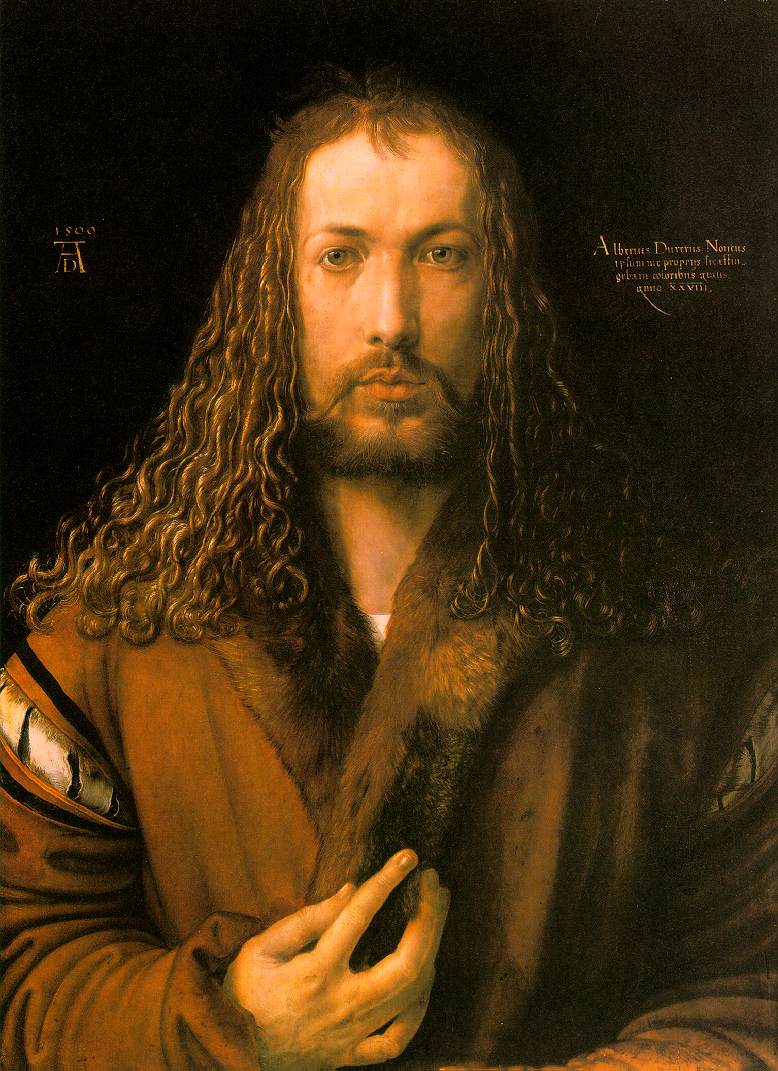
Durer's Self Portrait


Albrecht Durer created his Self Portrait in 1500. It was created during the High Renaissance in Northern Europe; he used oil on wood to create the painting. What I liked about this painting is how majestic Durer portrait himself to be. He appears to be confident, self assured, and knowledgeable. This painting is known to be similar to medieval Christ-like portraits (as can be seen with his shoulder length hair, for example). The writing on the painting shows that he was 28 at the time. 

Hans Holbein the Younger's The French Ambassadors


This unique painting is by Hans Holbein the Younger and was made in 1533. It was created during the High Renaissance period; Holbein used oil and tempera on wood to create this painting. It shows two ambassadors with items that reference to knowledge and humanism. One reason why this painting struck out to me was because of the distorted skull image. It only appears when the viewer looks at in at an angle, or using a cylindrical mirror. In a majestic portrait of two humanists, the skull seemed a bit out of place. However, it is said to symbolize death. The skull gives a unique appearance to the overall painting. 

Monday, October 15, 2012

Michelangelo's Moses


Michelangelo's Moses was created between 1513-1515. It is made of marble, and is massive (over 7 ft tall!) This sculpture is extremely life like (a very naturalist characteristic); Michelangelo paid great attention to detail. We can see this through the folds of his robe, the expression on his face, the contour of his muscles, and the ways his body is synonymous with what he is doing. It seems as if Moses is about to get out of his seat. This sculpture was created during the High Renaissance period in Italy.

Sofonisba Anguissola's Portrait of the Artist's Sisters and Brother


Sofonisba Anguissola's Portrait of the Artist's Sisters and Brother really stuck out to me in this chapter. Unlike the other works, this painting is set in a simple, green backdrop. There is no fancy landscape; it shows the siblings in all the naivety. It was made in 1555 using oil on wood. This painting was created during the Mannerism era. The expressions on the children's faces are solemn and simple. She detailed each of their expressions very well; it almost looks like a photograph would at a family photo shoot at Olan Mills.

Monday, October 1, 2012

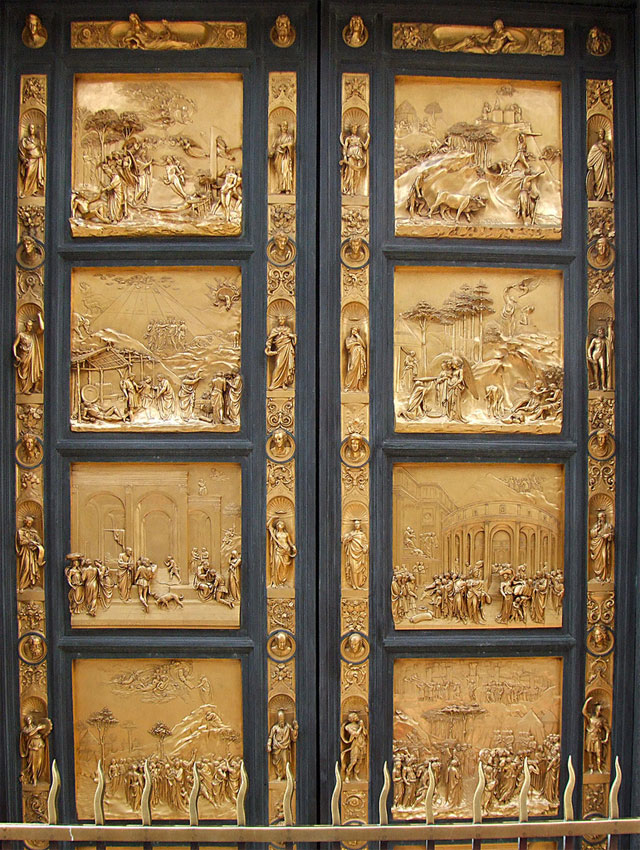
Lorenzo Ghiberti's Gates of Paradise


Lorenzo Ghiberti created Gates of Paradise on the east doors of the Florence Baptistery from 1425-1452. This was made during the Renaissance period. It is interesting to note here that Ghiberti was actually Brunelleschi's rival during that time. The piece is made out of gilded bronze material. It is extremely tall and heavy! On the door, multiple scenes of a story are shown (as was common during that time; due to the low literacy rate, people would rely on artwork like this to show them biblical events). 

Primavera by Sandro Botticelli


Primavera by Sandro Botticelli was made in 1482. It is a Renaissance painting that is made on tempera on wood. It is located in Florence, Italy. This painting encompasses a scene including Venus, Cupid, a nymph, and other mythological creatures. The stance of Venus is striking, as it shows a move to a more sensual depiction of mythological creatures. Venus has a Halo around her, as seen through the landscape background. Also, it is interesting to note that the orange fruits are symbolic of the Medicci Family, that held its strong presence in Italy. 

Wednesday, September 19, 2012

Saint Luke Drawing the Virgin - September 19, 2012


Rogier van der Weyden made this striking painting, Saint Luke Drawing the Virgin, somewhere between 1435 and 1440. This was made during the Late Medieval to Early Renaissance art period.  Like Giovanni Arnolfini and His Wife, this was created during a time when portraits were widely used as an art form. Detail to color, expression, stature, and dimensions were greatly looked after. An interesting aspect to this painting, that was included in many Flemish paintings during its time, was the large window that panned out to the town in the background. The attention to detail of the town is amazing-the viewer can truly get a feel for the scene. The other aspect of the painting is that the portrait artist is pictured in the painting itself. Usually, this was not very common as portrait art just focused on who the portrait was being made of. It is shown that the artist is painting the Virgin Mary and the Christ Child; for him to be in the same area with those two is something that would not be heard of making today. However, during that time, it was not uncommon for people to be painted along with the Virgin Mary and Christ Child. 

Giovanni Arnolfini and His Wife- September 19, 2012


This piece of artwork is called Giovanni Arnolfini and His Wife and was created by Jan Van Eyck in 1434. It was created in Flemish art form and portrays a middle class couple in their home. It is largely assumed that a wedding is taking place, due to the one candle in the chandelier, the puppy at their feet, the fancy clothing, and other characteristics. This was created during the Late Medieval and Early Renaissance Period, when portraiture was established as an important art form. Jan Van Eyck created an oil painting on wood. During this time, there was great amount of emphasis on detail, expression, color, and the natural world as a whole. We can see this through each of their expressions, clothes, and house ornaments. One of the reasons why I love this painting, is because I have actually seen this painting in real life in the National Gallery in London. It is even more beautiful in person. Another reason is the mirror in the background; it shows the reflection of the painter in the background (also a Flemish characteristic). This gave the painting a lot of character and alluded to the fact that Van Eyck was actually present during whatever transaction was going on. It is also interesting to note that the painter added his signature stating that "Jan Van Eyck was present here" instead of a simple signature at the corner of the painting.